
Appearance
Routing
Customers choose a payment method; RelyPay chooses the provider that takes the money, resolved fresh per transaction. Configure it under Addons → RelyPay → Routing.
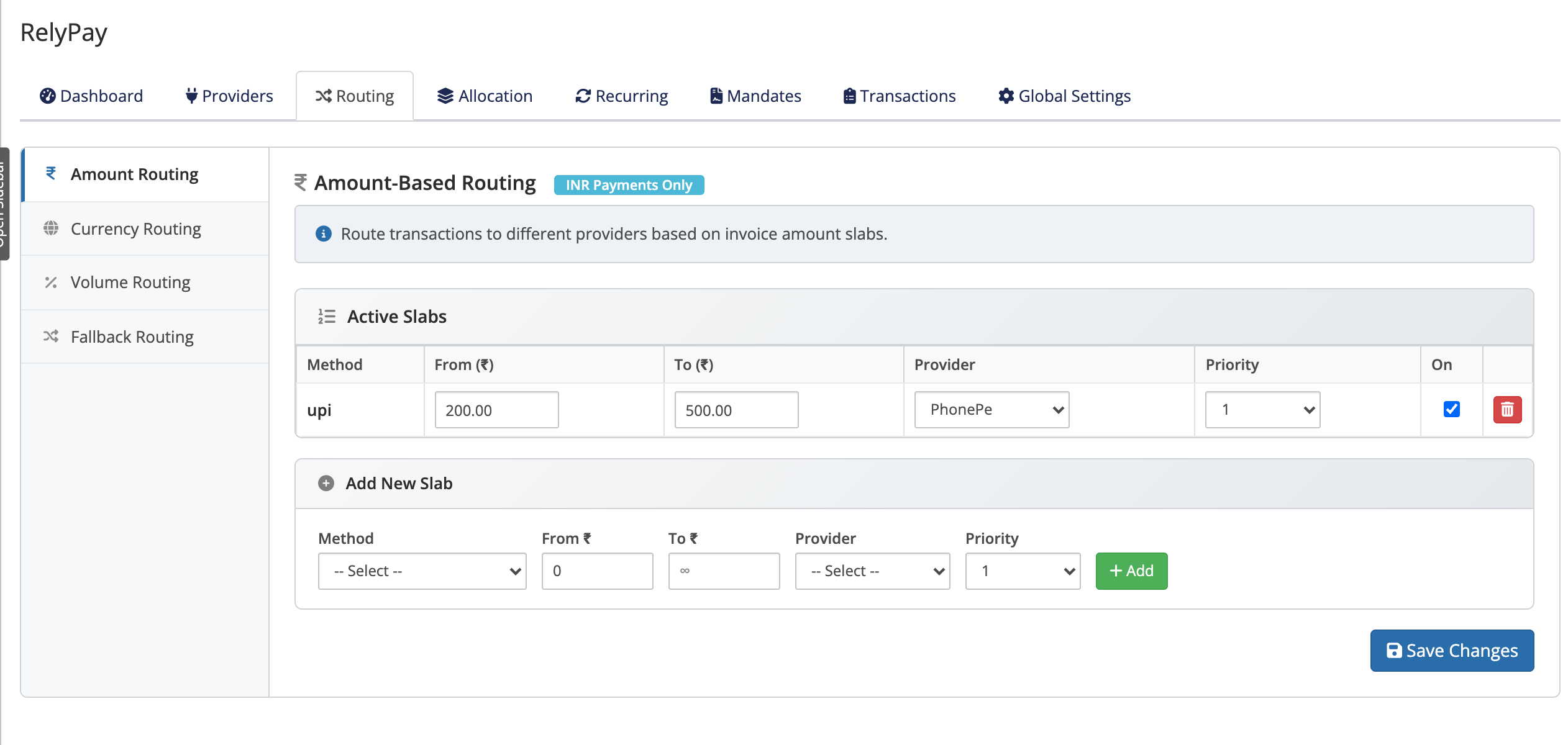 Addons → RelyPay → Routing
Routing vs Allocations
Routing = which provider takes a payment. Allocations = which checkout options a customer sees. Separate tabs.
The four layers
Rules are evaluated in a deterministic order where the first layer matching an active, fully-configured provider executes:
- First-match evaluation: Subsequent layers are skipped once a valid match resolves.
- Graceful degradation: Rules pointing to unconfigured or disabled providers are bypassed automatically to prevent checkout disruptions.
| # | Layer | Scope | How it decides |
|---|---|---|---|
| 1 | Currency routing | non-INR | One or more providers per currency (USD, EUR, GBP…). Several providers on one currency rotate randomly by weight (higher = larger share). |
| 2 | Amount routing | INR | Amount slabs (From ₹ / To ₹) → provider, each with a priority (1–5). Send small tickets to a cheaper provider, larger ones elsewhere. |
| 3 | Volume routing | INR | Percentage split across providers (1–100%), e.g. 70% Razorpay / 30% Cashfree. Balance load or phase in a provider. |
| 4 | Fallback | INR and non-INR (separate) | Default when nothing above matches — a priority chain (1–5); RelyPay uses the first enabled, configured provider. |
Resolution order — non-INR: currency → fallback. INR: amount → volume → fallback.
Worked examples
| Payment | Result |
|---|---|
| ₹499 UPI, slab ₹0–₹1000 → Cashfree | Amount slab matches → Cashfree. Volume/fallback never reached. |
| ₹5,000 card, no matching slab, 70/30 split | Drops to volume routing → ~70% Razorpay, ~30% Cashfree. |
| $120 card, rule USD → PayGlocal | Currency routing matches → PayGlocal. |
| SGD with no rule | Currency/amount/volume all miss → non-INR fallback chain. |
Fallback: INR vs non-INR
Set separately, because the right providers differ:
- INR fallback — domestic safety net (UPI, Cards, Net Banking…). Order your best domestic providers 1–5.
- Non-INR fallback — international safety net (international cards, PayPal). PayGlocal usually belongs high here.
Always keep a fallback ready
Put at least one enabled, fully-configured provider at the top of each chain so customers can always pay.
Activation seeds default routing with PayGlocal as the default recurring provider. Review and adjust under Addons → RelyPay → Routing.
Related pages
- Allocations — which sub-gateways each customer sees
- Sub-gateways — the checkout options customers pick
- Configuration — connect the providers routing chooses between
- Transactions — which provider each payment used