
Appearance
MCP tools
Relyagent provides 62 tools across 10 functional groups, categorized into read (query data) and write (modify state) operations. Administrators select allowed tools per connection under MCP Clients (see Connections & OAuth).
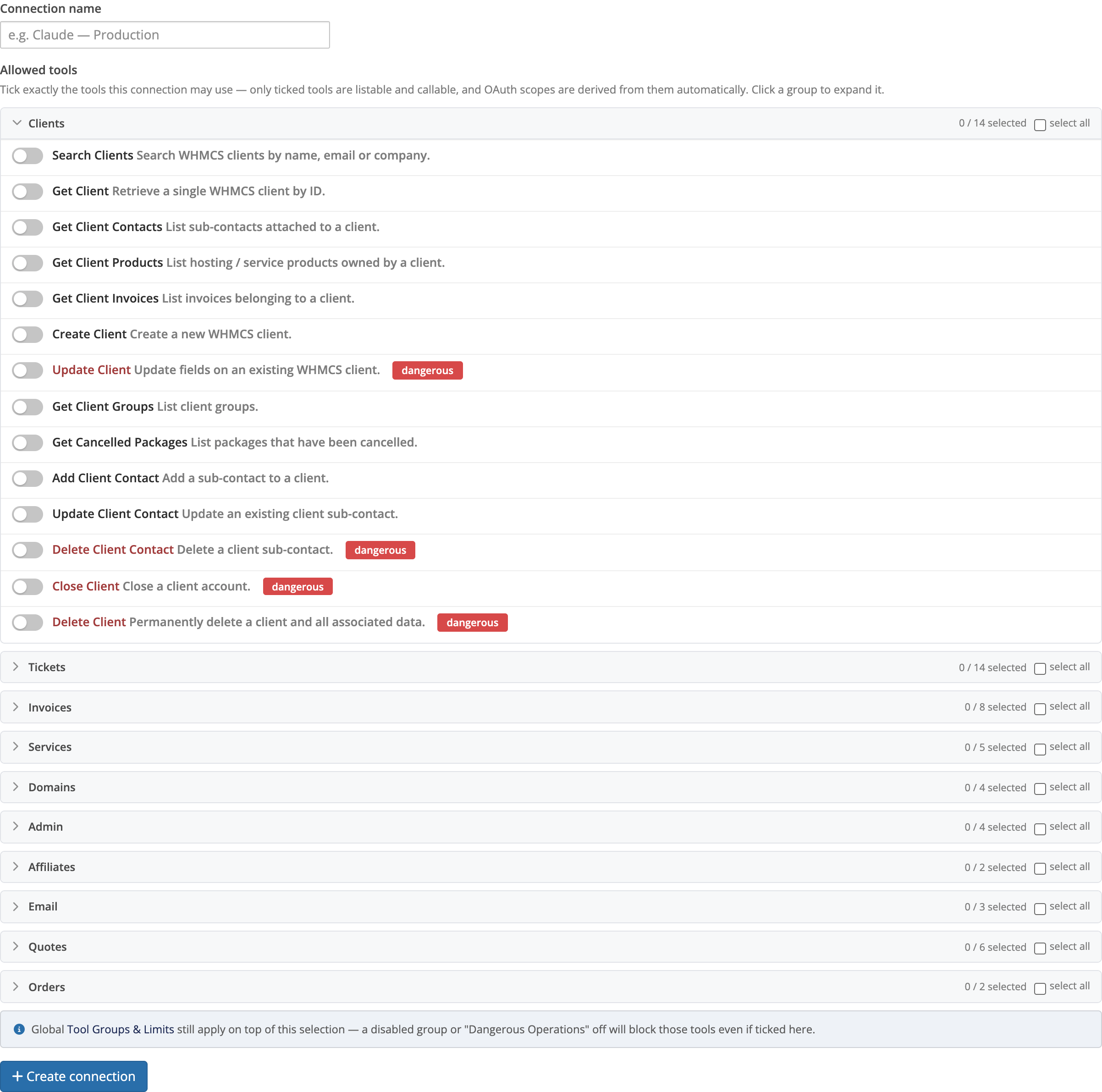 Addons → Relyagent → MCP Clients → New connection
The 10 groups
| Group | What it covers | Representative tools | Read/Write |
|---|---|---|---|
| Clients | Client records and contacts | search clients, get client, list contacts/products/invoices, client groups, add contact (read); create client, update client, delete client contact, close client, delete client (write) | |
| Tickets | Support desk | list/get tickets, departments, statuses, counts, notes (read); create ticket, reply, update status, add note, delete ticket (write) | |
| Invoices | Billing | list/get invoices, transactions, credits, payment methods (read); apply credit, create invoice, add credit (write) | |
| Services | Client products/services | list client products, get product (read); update service, suspend / unsuspend / change package (write) | |
| Domains | Domain management | list client domains, get domain, lock status (read); update nameservers (write) | |
| Admin | System overview | system health, activity log, stats, due invoices (read) | |
| Affiliates | Affiliate program | list affiliates (read); activate affiliate (write) | |
| Messaging | email templates, client emails (read); send email (write) | ||
| Quotes | Sales quotes | list quotes (read); create/update/send quote, accept / delete quote (write) | |
| Orders | Orders | list orders, order statuses (read) |
Scopes are automatic
OAuth scopes are named <group>:read and <group>:write (e.g. clients:read, invoices:write). You never hand-edit them: ticking a read tool grants that group's :read scope, a write tool adds :write.
Enforced on list and call
Only the ticked tools are ever exposed. Relyagent enforces each connection's allowlist both when a client asks which tools exist (tools/list) and when it tries to run one (tools/call) — a tool that isn't ticked is neither listable nor callable for that connection.
Dangerous operations
State-changing tools are flagged as dangerous and disabled by default. They require enabling Settings → MCP Settings → Dangerous Operations in addition to being ticked on the connection. The 12 dangerous tools (badged in red) include:
update_clientdelete_client_contactclose_clientdelete_clientcreate_invoiceadd_creditsuspend_serviceunsuspend_servicechange_packagedelete_ticketaccept_quotedelete_quote
Execution requires both requirements to be satisfied:
- Global setting: Dangerous Operations must be enabled under MCP Settings.
- Connection scope: the individual tool must be ticked on the connection profile.
Calls made while the gate is disabled return an error stating the tool is deactivated.
WARNING
Turn on Dangerous Operations only when you truly want AI clients to be able to change state — suspend services, create invoices, apply credits, and so on. Leave it off to keep every connection effectively read-only regardless of what is ticked.
Tools from disabled groups or unselected tools are completely hidden from client listing and execution. Adding a new tool to an existing connection requires client reconnection and fresh consent (see Connections & OAuth).